Public Interest x Customer Interest = Infinite Value

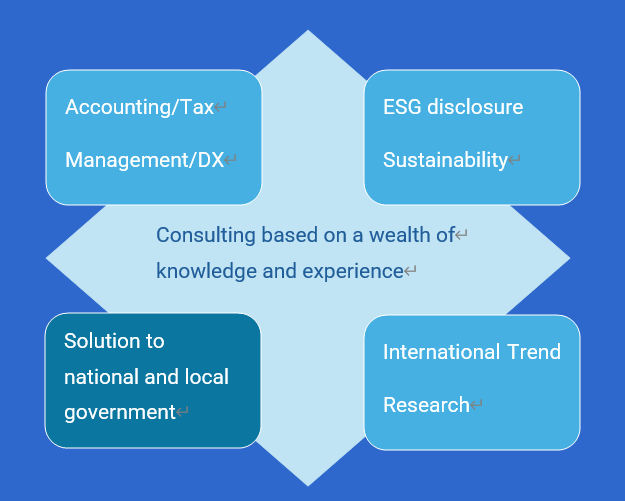
・Business Strategy・Financial Strategy Consulting

・External Audit Advisory  

・Tax Planning Advisory 

・Digital Transformation Consulting 

Compliance with regulations
​・Improving disclosure in securities reports
​・Preparation for Japanese versions of S1 and S2
・Establishment of a consolidated information collection system
​・Supply chain compliance

Investor Relations
​・IR Strategy to improve ESG ratings
・Acquisition of sustainablity assurance
​・Improved integrated reports/ web content

・In Japan, disclosure of sustainability information in securities reports will become mandatory from the fiscal year ending March 2023. A public draft of the Japanese version of S1 and S2 was published in March 2024, and it is expected that a considerable number of companies will apply the standards early from the fiscal year ending March 2025.

・It is becoming commonplace for listed companies to promote their ESG initiatives. Our firm has certified public accountants with extensive experience in disclosure systems who can provide advice on what kind of sustainability disclosure will be required in the future.

・There are some aspects of sustainability disclosure that are required as a response to regulations. However, we will work together with the company to come up with ideas so that these efforts do not end up being merely a response to regulations.​

・For example, if your main customers are large companies such as global corporations, you may be able to create business opportunities by taking a strategic approach to sustainability, as they are part of your supply chain. There are also cases where sustainability disclosure has led to the establishment of an efficient internal management system.

  • PFI and public-private partnership scheme building
  • Market sounding support
  • B by C, economic impact calculation and support
  • Public accounting-related business support
  • Other policy planning support
  • In the area of ​​managing public facilities, PFI methods such as concession methods and designated manager systems, as well as public-private partnership methods, are becoming more common.
  • The public and private sectors each have their own strengths and weaknesses. Private companies are characterized by their management of business performance based on accrual accounting, and their know-how in balancing the pursuit of economic rationality with the improvement of customer satisfaction.
  • The biggest challenge in public-private partnerships is how to utilize the capabilities of private companies while striking a balance with public objectives, such as maintaining the necessary levels of quality control.
  • Our consultants, including our CEO, are experts in public-private partnerships, having been involved in the design of concession-based systems at the Ministry of Land, Infrastructure, Transport and Tourism’s Civil Aviation Bureau.
  • Our extensive experience and understanding of the true purpose of PFI enable us to provide agile advice that benefits our clients.
  • With this attitude, we will support the national and local governments and create infinite value by pursuing both the public interest and the interests of our customers.
  • Research on international disclosure trends 
  • Research on trends such as IFRS/USGAAP
  • Translation/summary/reporting of overseas literature/papers
  • Research on systems and trends in each country

・Graduated from the Faculty of Economics at the University of Tokyo. MBA from the University of Manchester.

・After working at Fuji Bank, he joined Asahi Audit Corporation (now AZSA Audit Corporation) in 2002. He is in charge of financial statement audits, M&A, and overseas business for financial institutions. He also worked at KPMG’s Los Angeles office.

・He was responsible for concessions at Kansai International Airport, Itami Airport and Fukuoka Airport at the Civil Aviation Bureau of the Ministry of Land, Infrastructure, Transport and Tourism. He promoted airport management reforms, including organizing the tax and accounting of PFIs. He became independent in 2016. He currently works as a certified public accountant and tax accountant, and is involved in a wide range of activities from academic activities to consulting.

・He is a visiting professor at Rikkyo University Graduate School, an adjunct lecturer at Kokugakuin University Graduate School, a senior researcher at the Japanese Institute of Certified Public Accountants, and a member of the Japanese Tax Accounting Association.

(Research Papers)

・”Trends and background of financial accounting discussions regarding fair valuation of unlisted shares” Weekly Management Finance, March 4, 2024 issue

・”Japan is facing an increasingly hyper-aging society, and the realization of digital transformation in inheritance is an urgent task” Weekly Finance and Fiscal Affairs, March 14, 2023 issue

・”The wave of digital transformation sweeping through tax administration and its impact on financial practice” Weekly Finance and Fiscal Affairs, January 17, 2023 issue

・”The current state of tourism-related tax systems and economic issues – focusing on accommodation and hot spring taxes” PHP Policy Review, October 2019 (Co-authored with Yasuyuki Iida)

・”Current Status of Airport Concessions – Towards the Development of Practical Reports for Operating Rights Accounting” Weekly Management Finance, November 23, 2015 issue

・”Corporate Tax and Accounting Issues for Operating Rights of Public Facilities, etc.” (Co-authored) Accounting and Audit Journal, April 2015 issue

(Books)

・Beyond the Fintech Era (edited and written, July 2022, Kinzai)

・10 Magical Phrases to Understand Accounting to Your Surprise (April 2020, Kodansha)